

Gort is a market town in the west of Ireland, located in south Galway. The town is located approximately 32 kilometres south of Galway and 64 kilometres north from Limerick on the Atlantic Economic Corridor. Gort is connected to the M6 Galway to Dublin motorway via the N18 at Oranmore and via the N66 at Loughrea.
The railway station within the town centre operates daily connections to Galway and Limerick, as part of the Western Rail Corridor. Shannon airport is approximately a 40-minute drive from the town. The strategic geographical location of Gort makes it accessible to most major towns and tourist attractions in County Galway and County Clare.
As an early settlement, Gort developed on elevated ground adjacent to the present Market Square which forms the principal open space and focus of the town. The expansion of the town has occurred on relatively flat, low lying land surrounding the square. The Cannahowna/Gort river, which meanders from the south through this land, is subject to considerable flooding and has acted as a constraint on the development of some areas. The Ennis – Athenry portion of the Western Rail Corridor railway line runs parallel to the river, and this too has tended to act as a physical barrier to the expansion of the town centre.
Gort town has a rich architectural history that spans several centuries since its founding in the mid 18th century. Most significantly, two civic spaces lie at its heart, the Market Square and Canon Quinn park to the rear of St. Colman’s Catholic church. Other important spaces include the graveyard of the former Church of Ireland. There is also a substantial amount of private open space in the town centre mainly in the form of yards and gardens to the rear of buildings. These backlands offer considerable potential for future development including access which should take place in a planned and integrated manner so as to maintain the town’s character. Church Street and Queen Street form part of an urban block with Bridge Street and Market Square at the centre. Barrack Street, running broadly northeast from Market Square, leads to an area which includes the former barracks, workshops and the local Garda Station. The main road through the town forms part of the R458 and encompasses Crowe Street, Bridge Street and George’s Street. Gort is also served by bus routes 434, 51 to Galway as well as the 934 to Loughrea.
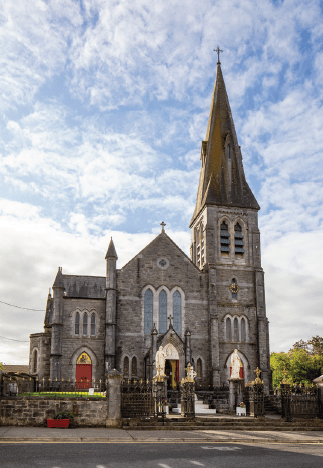
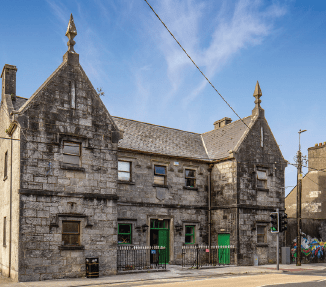


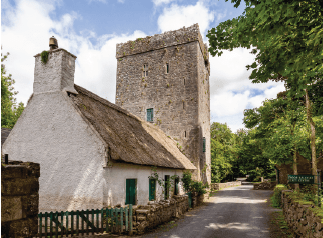
Buildings lining the main streets vary in size, style and age, those fronting Bridge Street and around Market Square are generally more imposing, typically 3 stories. Towards the edges of town, along the southern end of Georges Street, Crowe Street and western end of Church Street, most buildings do not exceed two stories.
Gort provides an important retail, educational and service function for a catchment area, extending into County Clare. There are significant employment opportunities within the town, which has a active commercial core. Retail and commercial uses are primarily located along Bridge Street and around Market Square. The IDA continues to manage a business/enterprise park to the west of the town and adjacent to the M18 motorway. Residential growth within the town has been (mainly) located to the northwest and south of the town centre.
The town of Gort has 2,870 inhabitants according to the 2022 Census. However, it is noted that the geographic definition of Gort as a settlement has changed from the 2016 Census to the 2022 Census, therefore any comparison between the population figures can give a false impression. Based on the comparative analysis of settlement size, in real terms, the population of Gort is 3,155 inhabitants, based on the settlement boundaries in the 2016 Census. This represents 5.4% population growth in real terms from the 2016 Census. Prior to the 2022 Census, the population of the town had remained relatively stable for approximately 10 years, prior to which there was a significant growth in population between the years of 2002 and 2006. Between these years, the Census recorded an increase from 1,776 (in 2002) to 2,734 residents (in 2006).
Gort is one of the most ethnically diverse towns in Ireland, with over one third of the population being non-Irish citizens. 15% of Gort’s total population is made up of citizens from countries outside of Ireland and outside of EU countries. This is compared with 2% of the population of the County (as based on the 2022 Census figures). This can be partially attributed to the significant Brazilian population that moved to reside in Gort primarily for employment from the 1990s onwards, and Gort is now often referred to as ‘Little Brazil.’
Gort’s local economy benefits from tourism attracting both national and international visitors. Significant tourist attractions include Coole Park, Thoor Ballylee, Kilmacduagh Monastic Settlement, while Gort also benefits from proximity to the Burren. Gort is also within Ireland’s Hidden Heartlands, a popular touring route of rich landscapes and rural towns. It is relatively close to the Sliabh Aughties, a mountain range in West Ireland. The Wild Atlantic Way, a 2,500km coastal road from County Donegal to County Cork, is within the region of Gort and is part of the Burren Discovery Trail. Finally, Gort is set to be a destination on the emerging Galway to Athlone Cycleway project which is expected to bring an increase in visitors
 Gort Town Centre First Plan